Disclosure: Joyfully Domestic may earn a commission for purchases made after clicking links on this page. View our disclosure policy for details.
In this post, I’m sharing our Traditional Catholic + Charlotte Mason homeschool curriculum picks for 2026 – 2027. This year I have students in Forms 1, 2, and 3 (years 2, 5, and 7), as well as a special needs child.
Our Homeschool updates
Last year, we dabbled with continuing to combine TCT with The CMEC. But have since dropped TCT and will continue to use The CMEC with some options from Ambleside this year. And I am heavily supplementing with Traditional Catholic books too.
I recently wrote about our experiences with both here: Our 5-Year Experience with The CMEC + Why We Stopped Using TCT.
I wasn’t sure if I was going to write this post or share much about what we are using this year. But, I still get a lot of traffic to my previous years’ posts. So, I hope that they are still helpful for you!
And as we are combining curriculums a bit, I will try to keep this post organized by what we are supplementing with this year.
I also want to mention that I have started putting together blog posts with curriculum by year and will go a bit more in depth of what we are doing for each grade in those posts. You can find all of those posts in this curriculum tag on the site.
Common Subjects
These are the subjects that we will complete together as a family. Generally, it is usually with our morning work, bible, and liturgical and spiritual life, and more. The children do have additional catechism and spiritual life readings that I will share further on in this post.
For our morning time we rotate through:
- Prayer together — In the past we would usually begin with the Morning Offering and a few other short prayers. But as the children have gotten older, they pray their morning offering on their own as soon as they wake up. So now, we pray the Consecration to Our Lady of the Trinity, Memorare, and a few other short prayers together before lessons.
- Old + New Testament—we alternate these and follow the schedule from The CMEC.
- Baltimore Catechism — I pull a few questions for our “lesson catechism” time in the morning. The children receive individual catechism lessons as well.
- Lives of the Saints — read daily. We also enjoy this Character Calendar each day.
- Spiritual Reading — varies and usually (but not always) something from Mother Loyola or Ronald Knox. (see more under religion + catechism below. Cluny Media and Cor Jesu Press have some of our favorite spiritual reading books.
- Devotionals — usually based off the Liturgical season and read together as a family. I love a variety of options from TAN Resurrection series and the daily meditation books written by St. Alphonsus Ligouri — here is the Advent and Christmas version.
- Hymns + Folk Songs — I use seasonal or liturgical hymns (usually in Latin). Lingua Angelica (skip the workbooks) is a great place to start if you’re new to Latin hymns. And we follow The CMEC’s program for folk songs.
- Artist study + Composer study — following with The CMEC.
- Fables — daily a short reading from Aesop.
- Habit training — from Simply Charlotte Mason. And we also enjoy these Manners of the Week cards. We have also enjoyed some sections from Connoisseur Kids too. It covers a wide variety of etiquette and manners that we’ve enjoyed.
- Shakespeare — Usually as a part of our Fine Arts Fridays. See more about how we learn Shakespeare together. And we are following along with the term schedules from The CMEC.
Related: Musical Education in the Classical Homeschool
I know that this seems like a lot. But it really isn’t and we usually finish in under an hour. A lot of it alternates and is looped throughout the week.
Afternoon Occupations
We also have blocks in the afternoon time each day where we loop through these together:
- physical exercise, folk dancing, Swedish drill, or other physical exercise; together daily. The Schoolyard Co has great options for Swedish Drill and other physical activities that we’ve enjoyed. I have a coupon code for you to save 10% off at The Schoolyard if you’re interested. Use code: MARYWOITA for 10% OFF.
- term biographies, and more lives of the saints / catholic heroes
- nature study + natural history reading
- we’ve done Latin together, but the children are doing these independently now based on their readiness and skillset.
- Spanish (still using Cherrydale Press together as a family.) We are contemplating using this for French next year…TBD.
- literature or term novel
- poetry + tea time
- current events
- handicrafts
- watercolor or other art lessons
The children also have chores and free time blocks on the timetable in the afternoons each day.
Spiritual Formation + Liturgical Life
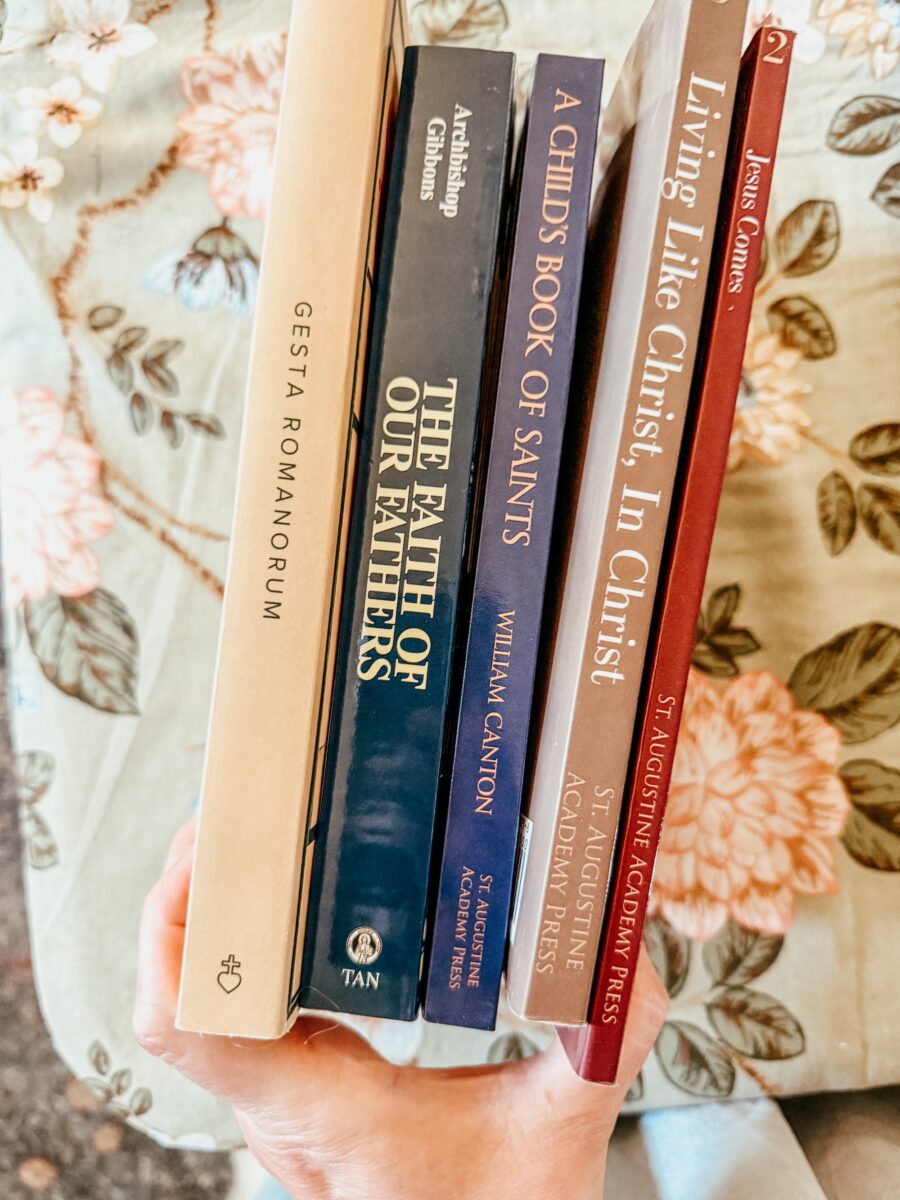
These are the books we are using for individual catechism lessons.
- Year 2:
- Jesus Comes
- First Communion Catechism (used last year and will use for review as she prepares for First Holy Communion).
- Year 5:
- Year 7:
- Faith of Our Fathers (split up with next year)
- A Catholic Girl’s Guide
- The Gesta Romanorum
- Special needs:
- we will continue to work through this The Catechism in Pictures book. She also enjoys listening to the Regina Martyrum saint stories on her Yoto.
We are use these as supplemental reading: Angel Food for Boys & Girls and Catholic Stories for Boys & Girls for form 1 and special needs.
I have also more favorite catechism sources in this post.
“Ignorance of Scripture is ignorance of Christ.”
St. Jerome
Bible Resources
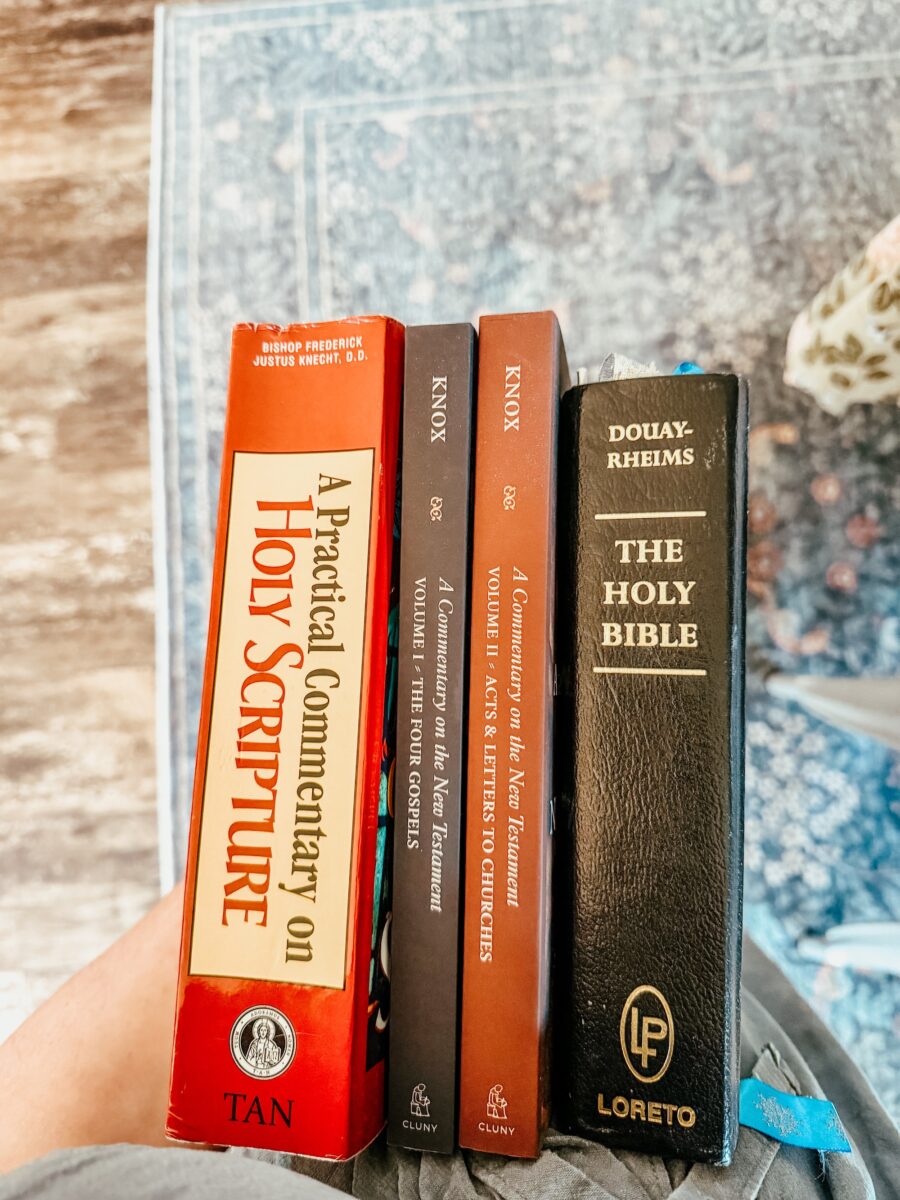
We are reading selections as scheduled by The CMEC from our Douay-Rheims Bible for the majority of our Bible lessons.
I also purchase the commentaries as recommended by The CMEC even though I don’t agree with a bit of the information in them. They are Protestant and biased, so I only use them to select some background information and seed thought/captain ideas for lessons. They are also only used by me and not for my students to read.
The majority of the Bible commentaries that I use are from these Catholic sources:
I also purchased these commentaries by Ronald Knox this year to supplement my preparations:
- A Commentary on the New Testament, Volume I: The Four Gospels
- A Commentary on the New Testament, Volume II: The Acts of the Apostles & Saint Paul’s Letters to the Churches
I wrote about how we do a bible study lesson according to Charlotte Mason’s method of lesson in this Holy Week Bible Study blog post.
In addition to these readings, we are using these bible atlas books for additional background information.
My form 3 student is also beginning a study of the Acts of the Apostles independently this year.
“…in order that the children may learn to love and trust our blessed Lord, it is above all things necessary that they should get to KNOW HIM; to become acquainted with Him in the same sense as one gets to know and become acquainted with a human friend.” — J. Paterson Smyth
History
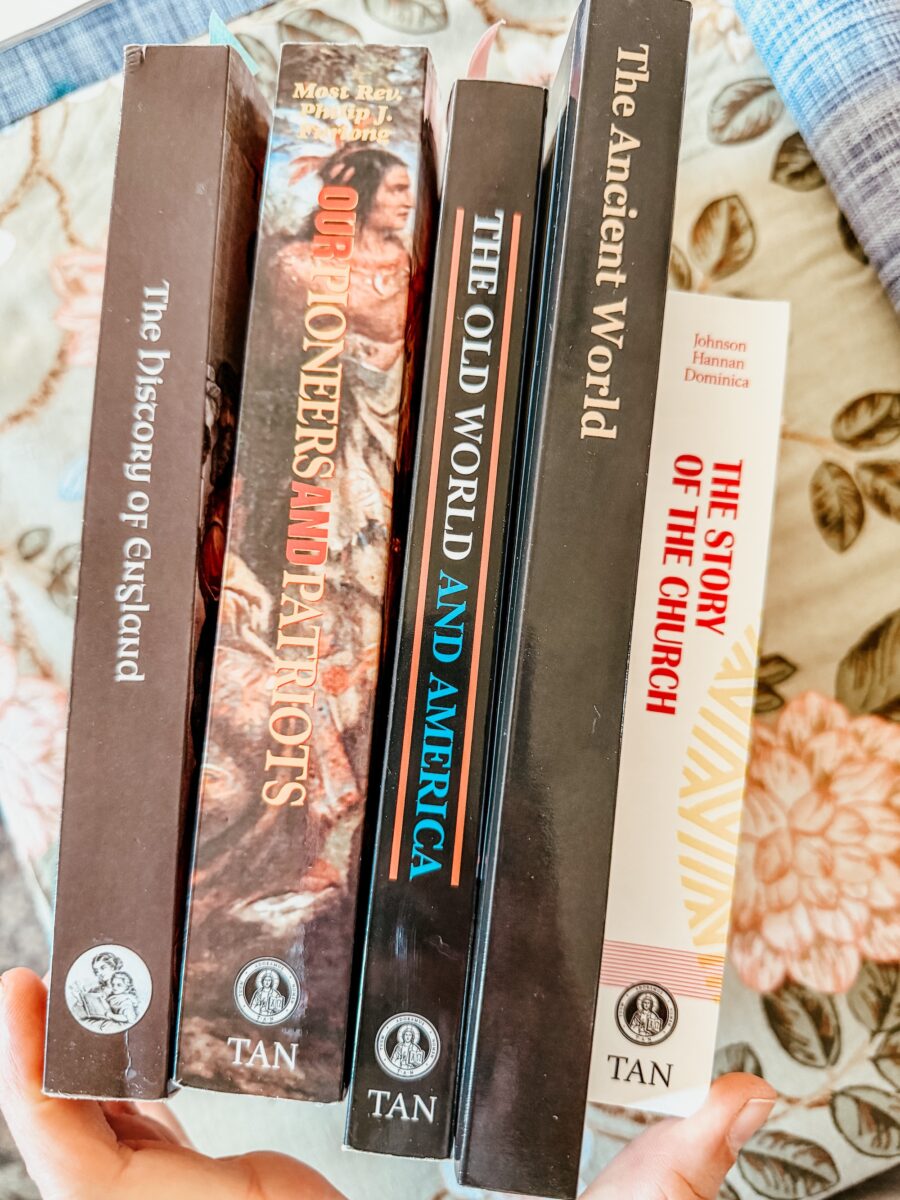
We are following continuing with the history books for my forms 2 and 3 students that I mentioned in our term 1 post from last year.
In addition, I really like the path that Ambleside is headed with history, so we are moving to the Medieval time period for form 3. She is also finishing up the Old World & America book while also using The Story of the Church alongside a few other books which I’ll list below.
My form 2 student is continuing on with Our Pioneers and Patriots for his American History and continuing with A History of England for Catholic Children for British History. We use this book spread over years 4, 5, and 6.
My form 1 student will continue with reading through the D’ Aulaires books that we did not read in year 1. And as a part of our historical fiction readings, we start to read through the Little House Series together.
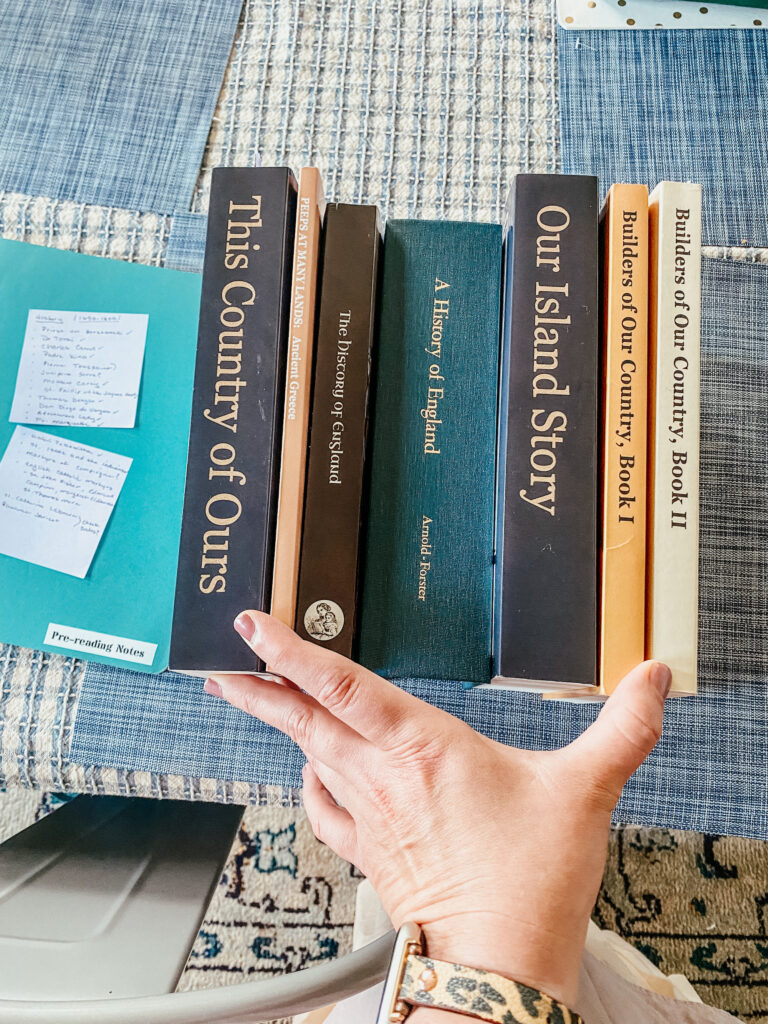
We also enjoy reading through selected chapters from Builders of our Country. This is something that was recommended by the CMEC and they select certain chapters from either Book 1 or Book 2 based on the timeline studied.
History Biographies
My children will also read through a variety of historical biographies of Catholic heroes of the time periods we are studying, and various saint novels.
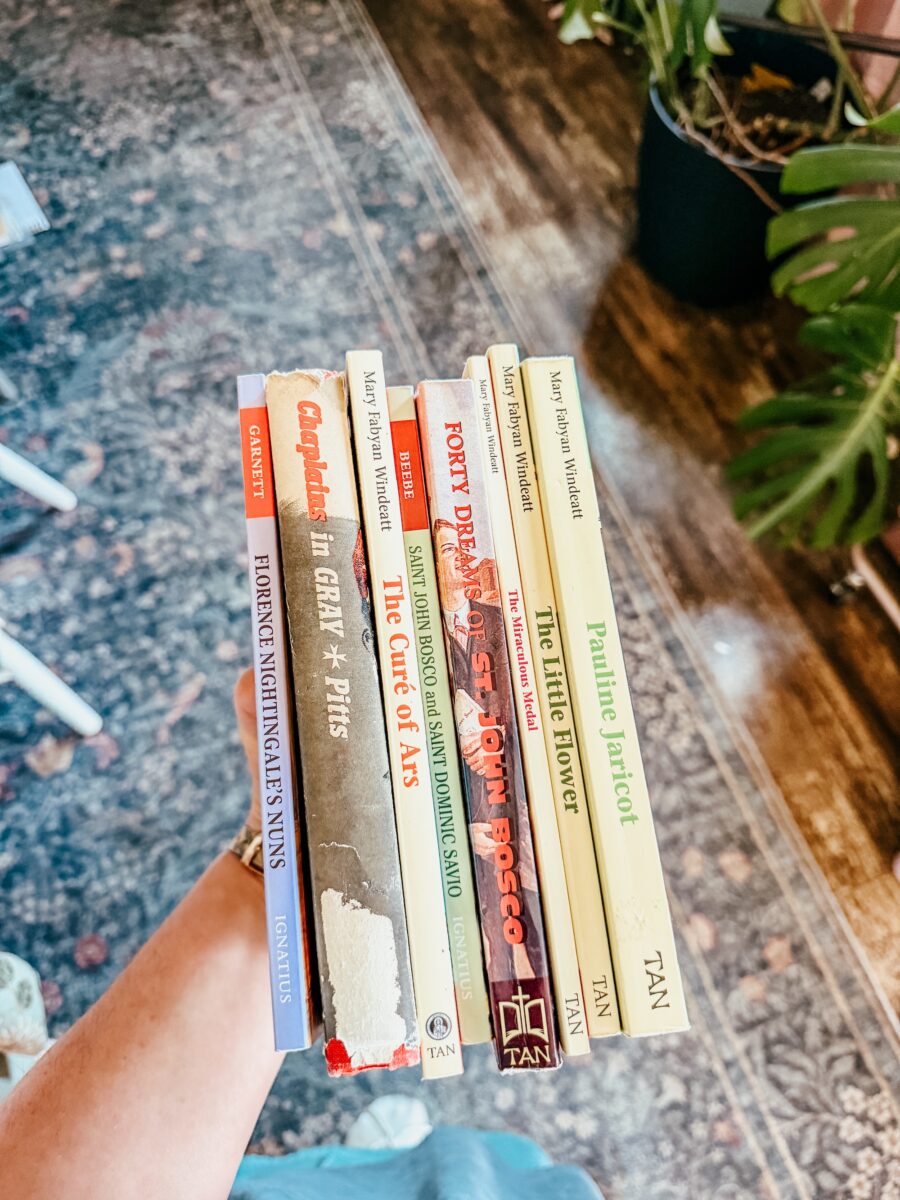
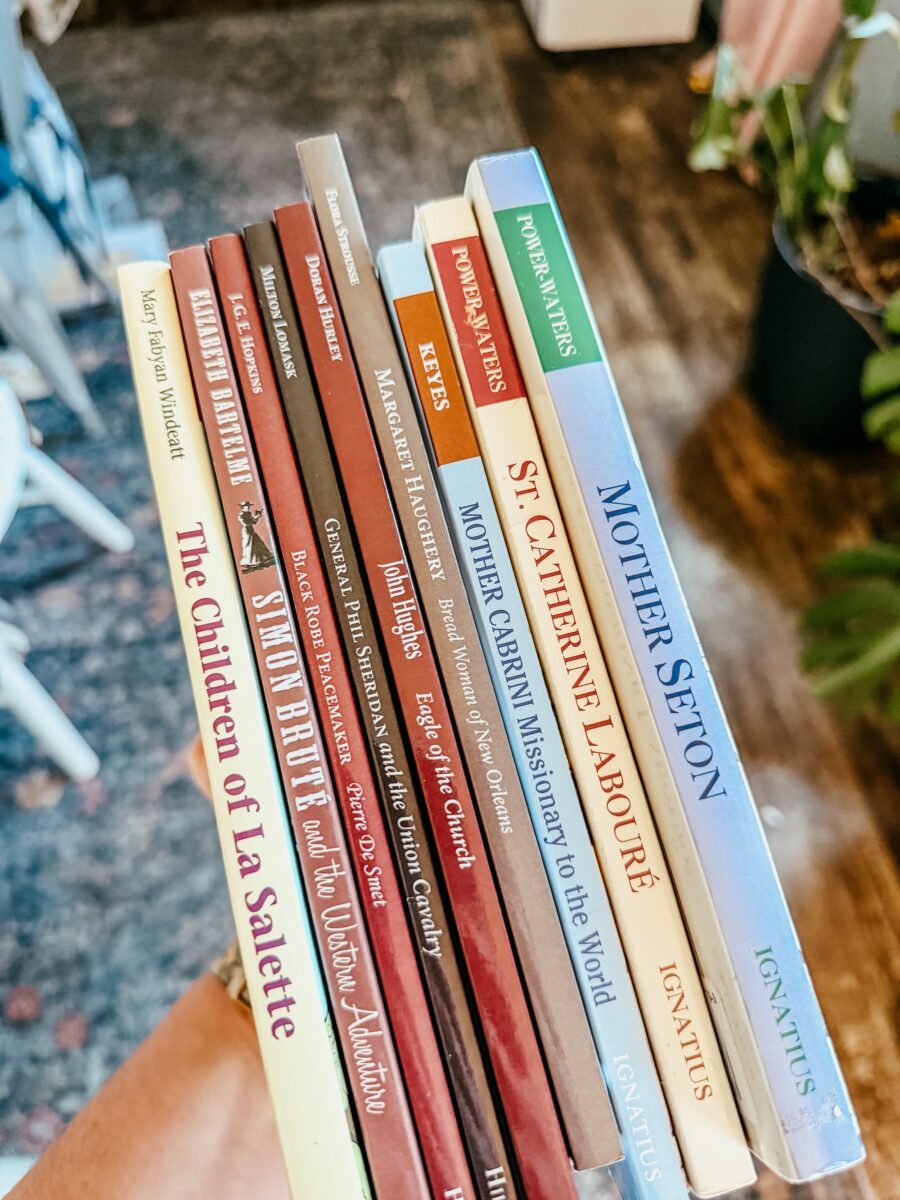
Here’s a few of them that I pulled from our shelves as possible options. Some of my children have already read these, others have not. So, I will assign 1 per term for each student and place the remaining on the TBR shelves for free readings.
For my Form 1 student (we’ll read aloud):
Extra readings as time allows:
For my form 2 student:
- Florence Nightingale’s Nuns
- St. John Bosco and St. Dominic Savio
- Mother Cabrini: Missionary to the World
Extra readings as time allows:
- Chaplain in Gray
- Black Robe Peacemaker
- Simon Bruté and the Western Adventure
- General Phil Sheridan and the Union Cavalry
- John Hughes, Eagle of the Church
- Margaret Haughery: Bread Woman of New Orleans
- St. Catherine Laboure and the Miraculous Medal
- Mother Seton and the Sisters of Charity
- Forty Dreams of St. John Bosco
Form 3:
- Bede’s Ecclesiastical History
- The Life of King Alfred by Asser
- Song at the Scaffold I still need to pre-read and may need to postpone for next year.
- St. Francis and St. Clare
- St. Dominic
- The Family that Overtook Christ
- Saint Louis and the Last Crusade
- The Bronze Bow
At the time of writing this, the Windeatt set is marked as half off at TAN Books.
I shared a bit about my take on how we approach anti-catholic bias in our history lessons in last year’s curriculum post. You can find that here under the history/biography section of the post: 2025-2026 Catholic Charlotte Mason Curriculum Picks.
Geography
Geography is one of the subjects that I really enjoy most from The CMEC. They put together a lot of great resources that I enjoy using.
Update: Since this post first published, I spent time reviewing several sources, I decided to use Simply Charlotte Mason this year for geography.
We are using their new geography curriculum, This Beautiful Earth. I really wanted to find something that was a bit more simplified and open and go for myself this year.
I am considering a few other options from Ambleside online and as I continue to pre-read and prep, I will write up what we are using or changing in the specific curriculum by year post series on the blog.
Again, you can find all of those posts in this curriculum tag on the site.
Citizenship + Economics
We are also using a combination of The CMEC and Ambleside for these subjects for the forms 2 and 3 students.
I love that I can combine my form 2 and 3 students for Plutarch this year and also enjoy how many Plutarch resources the CMEC puts together. They are all really well done.
My year 5 son is finishing up The Young Citizen’s Reader.
My year 7 daughter is also continuing with Ourselves by Charlotte Mason and beginning The Laws of Every-day Life. She will also use Whatever Happened to Penny Candy this year.
Literature + Poetry
We are using some of the recommendations from The CMEC for literature, novels, and poetry for forms 1 + 2 this year. And any extra additions are what I’m putting on my children’s free read shelves. And any additional Yoto / audio books they may enjoy in their free time.
Form 1:
Form 2:
- Fr. Finn series
- The Incredible Journey
- The Borrowers
- The Rescuers
- Number the Stars
- The Enchanted Castle
Form 3:
- The Age of Chivalry
- Page, Esquire and Knight
- The Magna Charta
- Augustine Came to Kent
- The Blood Red Crescent
Free reads for form 3 (she loves reading on her own, so I pulled extras for her to choose from):
- Under the Lilacs
- Justin Morgan Had a Horse
- Little Lord Fauntleroy
- The Enchanted Castle
- Journey to the Center of the Earth
- Around the World in 80 Days
- How the Heather Looks
- Son of Charlemagne
- The Gauntlet
- The Blue Gonfalon
- Fingal’s Quest
Language Arts
The basis of a language arts in a classical Charlotte Mason education is through narration, copywork, and dictation. Dictation and grammar are introduced in form 2 (year 4).
Related: The Foundations of Language Arts in a Classical Charlotte Mason Education
My form 3 student is moving in to more formal written composition this year. We are following with the CMEC’s recommendations for this. And we will see how that goes and if we need to supplement with anything further.
Form 1 (Year 2) language arts:
- Oral or drawn narration
- Copywork
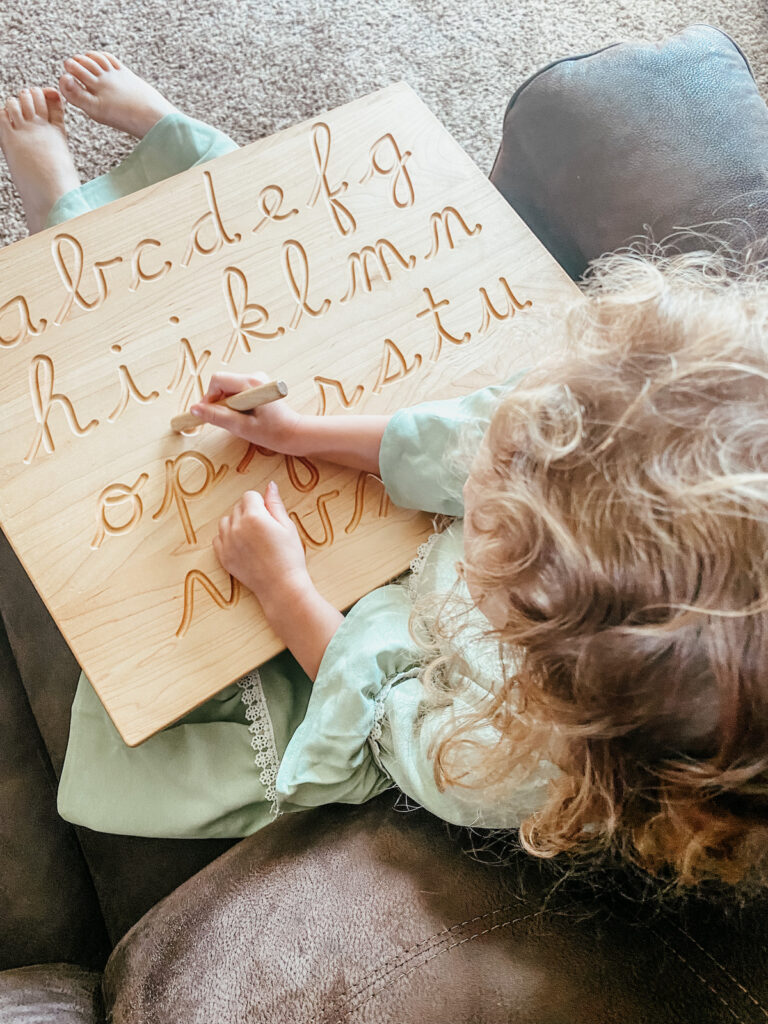
- We are using Rod & Staff for cursive practice / penmanship
She is also continuing reading and phonic lessons with me.
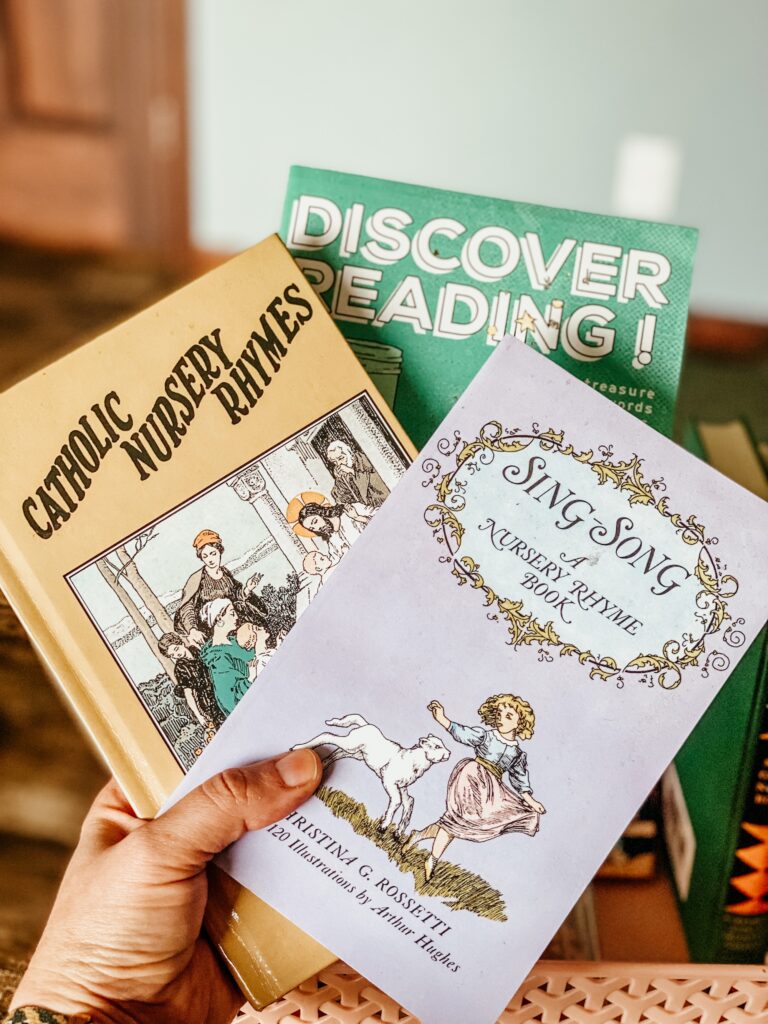
My students have been taught reading by following Charlotte Mason’s method as she described in Home Education and it has worked well. We have also have used some of the suggestions from the Discover Reading book. But I also add in extra phonics work in the early years.
- Discover Reading by Amy Tuttle
- We are using the McGuffey Pictorial Primer for extra reading and spelling practice.
- We’ve also loved this set of American Cardinal Readers to give more of a Catholic focus in our reading lessons.
- The Treadwell Readers are also great and we love to incorporate these into the mix for extra reading practice.
- We’ve also enjoyed the Little Angel Reader series for phonics instruction.
Form 2 (Year 5) language arts:
- Oral, drawn, or written narration
- Copywork
- Dictation lessons
- Using Language Well — for dictation and grammar lessons.
- Scriptorium Writing — for other composition lessons.
- Rod & Staff for additional cursive practice / penmanship
Form 3 (Year 7) language arts:
- Oral, drawn, or written narration
- Copywork
- Dictation lessons
- Written composition — we are mostly using the suggestions from The CMEC this year. But are also pairing it with Scriptorium Writing for other composition lessons as well.
- Grammar — Using Language Well
- Additional cursive practice / penmanship. This will probably only be in term 1 for her to improve a little bit more. She has a big interest in learning calligraphy, so we may dabble in that a bit for the remaining terms.
Latin
My form 2 student worked a bit with Getting Started with Latin last year and we will continue on with this a few of times a week.
My form 3 student and I will be using Lingua Latina per se Illustrata, Pars I: Familia Romana together.
We also practice hymns and prayers in latin throughout the year for extra practice as a family.
Math
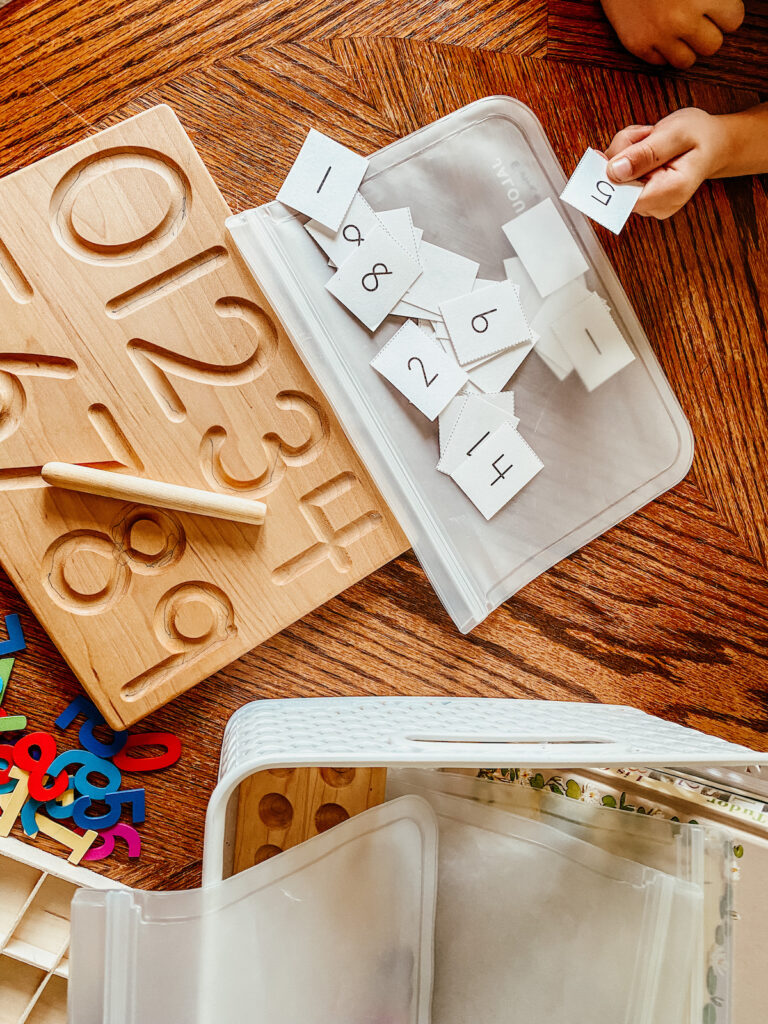
After a lot of back and forth and testing out a variety of math curriculums, we have chosen a combination. I’ve found that combining Rod & Staff Math with Life of Fred has been a really good combination for our family.
We started using LOF a couple of years ago as a fun way for the children to keep up on skills. They enjoyed it and so, we will continue using it a couple of days a week and as a compliment to our other lessons.
We will also work on Paper Sloyd once a week, in the afternoon.
I would like to introduce the Business math series from Simply Charlotte Mason. The lessons are built around the children running their own fictional business and they sound interesting…?
natural History + Science
We are pulling from both The CMEC and Ambleside Online for these subjects. We have not really enjoyed Life and Her Children by Arabella Buckley in the past.
I pre-read some of it and tried to use it when my form 3 student was younger…we just couldn’t get into it. And upon further discovery, I realize that she promotes evolution in these books. We do enjoy the Eyes + No Eyes series by Buckley though! I have not noticed any issues in the younger years, but have not read all of them. Please correct me if I am wrong!
For my family, I’ve found that we have a better time using Ambleside for majority of the nature study and science recommendations. I just pick and choose or combine a little in this area.
So here’s what we are using this year…
Year 2:
- Burgess Bird Book (we did the animal book last year)
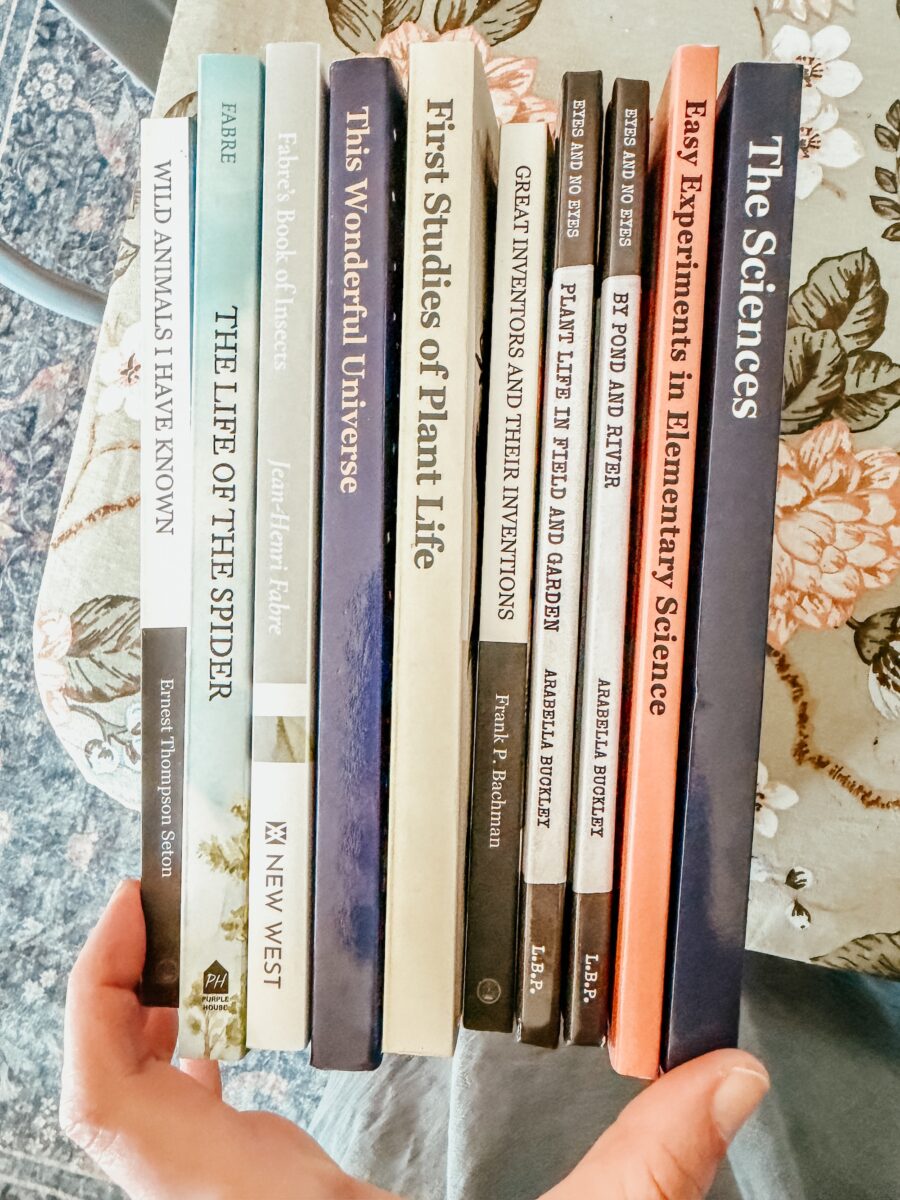
- Plant Life in Field and Garden + By Pond & River
Year 5:
- Wild Animals I Have Known
- The Sciences
- Exploring Creation with Human Anatomy and Physiology
- Madame How, Lady Why
- Great Inventors and Their Inventions
Additional Biographies:
Year 7:
- Eric Sloane’s Weather Book
- First Studies of Plant Life
- Fabre’s Book of Insects — I had considered Life of a Spider as recommended by Ambleside, but decided on the book of insects instead this year.
- This Wonderful Universe and/or Secrets of the Universe set (I purchased both and will pre-read to determine which one I want to use)
- The Wonder Book of Chemistry
- Adventures with a Microscope
- The Lay of the Land
- The Great Astronomers
Year 7 Health:
Fearfully and Wonderfully Made (still need to pre-read)
We’ve enjoyed the special studies suggestions from The CMEC and overall recommendations for natural history.
In addition, we will also work on experiments for my year 2 + 3 students.
- Handbook of Nature Study
- Special Studies — following along with The CMEC.
- Nature Journals
- Star Lore
- Seasonal nature books
Handicrafts / Artwork
The CMEC has a wonderful selection of Handicraft ideas that we’ve learned from over the years. And for my form 1 student, we may pick a couple for the afternoons this year.
My form 2 student really enjoys building things. He’s always been fascinated with the way things work. So this year we are going to do a few projects from the Tinker Crate from Kiwi Co and he is pretty excited about it!
My form 3 student really enjoys crafting and embroidery and she specifically requested to start with this cat embroidery set. She is continuing with various sewing projects with her sewing machine too.
She’s also dabbled in basic knitting and would like to learn more, so I’m currently on the hunt for a good resource. If any of you have suggestions, please let me know!
As far as artwork, we are using the recommendations of the CMEC this year. It’s been helpful for me to simplify and use what is already available in this area. We have also used Lily & Thistle, Bob Ross videos, and really a variety of other sources in the past.
Hi Mary,
I recently came across your blog and I’m really enjoying and learning all you’ve put into it! I am a Catholic mom to a 4 and 1 yo. I recently joined the CMEC to prep myself for homeschooling. It is a lot to go through right now! I have also come across TCT through The Commonplace, as I’m also a common mom there. I had a specific question on history with the CMEC…were the books just unenjoyable or did you feel there were “better” Catholic picks? If so, how do you find these better choices? Have you considered Mater Amabilis or RC history? If you have time, thank you and God bless!
Hello Megan! Thank you so much! 🙂 The books that The CMEC and even Ambleside recommend are usually written by Anglicans or other Protestants and often full of anti-Catholic bias. I usually avoid this in the younger years, but as the children get older, I allow for this on occasion to have meaningful discussions (never without proper guidance). But also, I’ve substituted many sources because certain important dates in our church history are missed and I also have very specific goals for my children and their education. I’ve mapped out the path of education all through the high school years and certain books that I select often prepare us for those future books and things. I have looked into Mater Amabilis and it is not something I would want to use in our home, but I know many who enjoy it. I’m not familiar with RC history.
I hope this helps!
God bless you,
Mary
Thanks! Are you going through the CMEC book lists and reading each 1 to know if they are anti Catholic or not? I guess that’s my hold up, with AO too. IDK how to discern which books are good or bad unless I read them? Would you be able to expand on why MA is not something you would want to use in your home?
Yes, I’ve only really found out through reading the books myself…a bit of trial and error in putting together the curriculum. I don’t like a lot of the books recommended by MA…some of which contains modernism and other things that we don’t agree with.
Hi, Mary,
I just vaguely remember a mention on TCT being neoclassical. Can you elaborate on that and why you had written in it being so? I could just be imagining it. I am doing CMEC and TCT this year. This is our 4th year homeschooling and I am just in need to really solidify our educational journey as Catholics.
Hmm…I don’t believe that I’ve said that and I don’t think that it is neoclassical at all. It is very classical and good, but just not for us.
Hello!
I noticed the book “The Ancient World” in one of the photos and was wondering what your thoughts are on that particular book? I’m in the throngs of prepping for the new school year and just ordered that one, but am always apprehensive of history books that are new to us. Thank you!
One more question, what are your thoughts on the book This Country of Ours? Thank you!