Disclosure: Joyfully Domestic may earn a commission for purchases made after clicking links on this page. View our disclosure policy for details.
In this post, I’m sharing our plans for year 4 curriculum as a Traditional Catholic + Classical Charlotte Mason Homeschool.
In case you missed it, I previously shared our experiences with The CMEC, TCT, Ambleside, Memoria Press, etc. and how I like to pull from a variety of resources when creating our own curriculum picks and structure.
You can find previous posts here.
Year 4 marks the transition from form 1 to form 2. And so there is a slight increase in work and changes in a few areas of the curriculum.
Religion + Catechism
We begin our morning time off with a morning offering, prayers, other liturgical devotions, bible readings, hymns, folk songs, etc. You can read more about our morning time here.
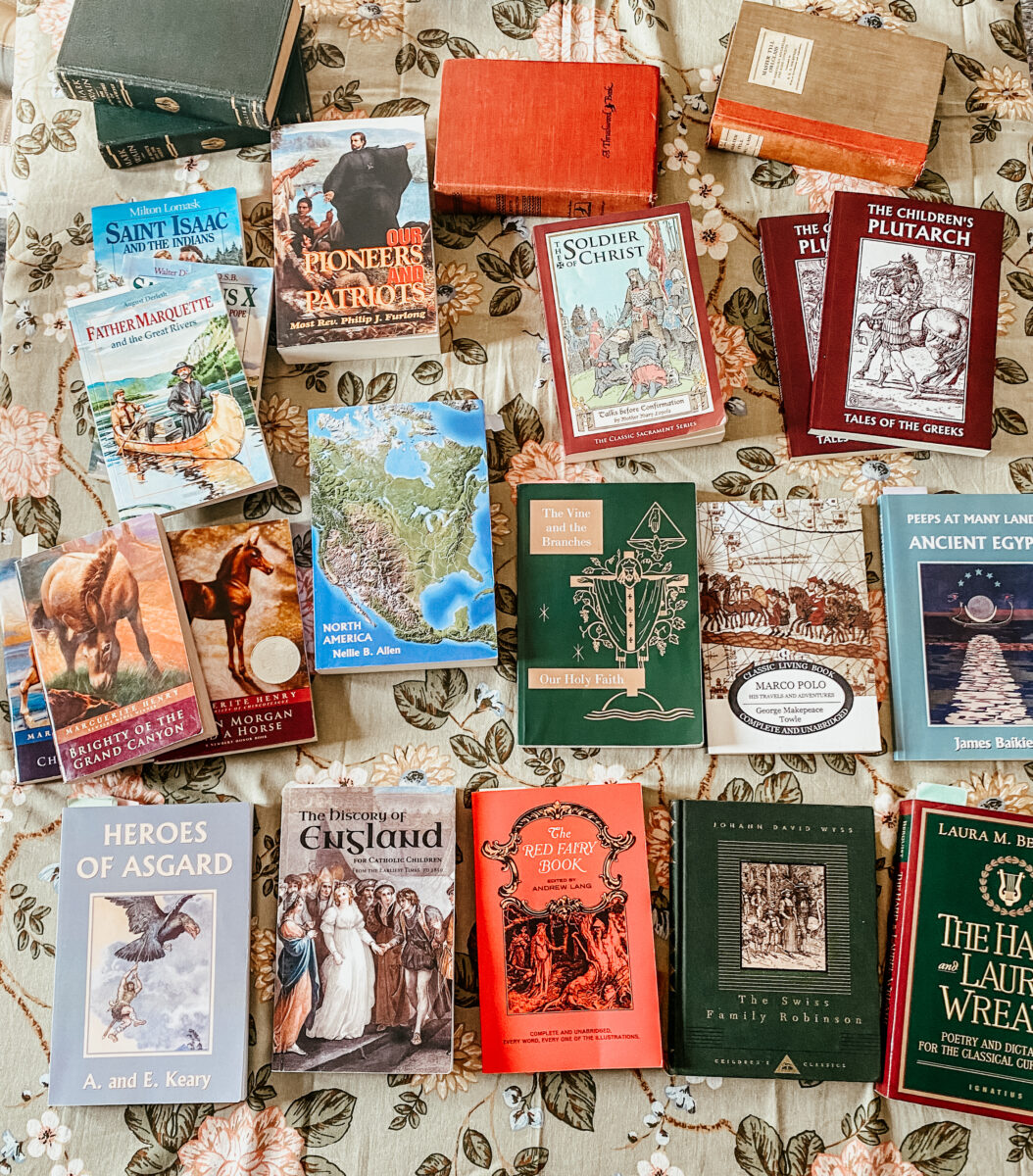
For my year 4 students, we continue with the Our Holy Faith series of catechism, The Vine and the Branches.
We continue reading through more saint stories, with any not previously read from the Windeatt Set. In addition, the children read more of these independently and will start to move on to the Vision books as well.
And usually by this time, my year 4 student would be preparing for the Sacrament of Confirmation. We will slowly read through The Soldier of Christ and Preparation for Confirmation by Baltimore Catechism.
I set daily time blocks for the student to read catechism, spiritual reading, and saint stories on our timetable.
math
In my previous posts of this curriculum series, I’ve explained our journey with math a bit. We combine Rod & Staff math as a core and Life of Fred as a supplement for our math curriculum.
That being said, as a Classical Charlotte Mason homeschool, I still keep the math lessons short (about 30 minutes for year 4). So, I break the lessons down and don’t fatigue the children with all of the extra practice sheets, complete workload of a suggested lesson, and speed drills, etc.
In year 3, we began using musical multiplication from the Good and the Beautiful a couple of times a week. If my year 4 student needs extra practice with memorizing, we would continue using this.
History + Geography
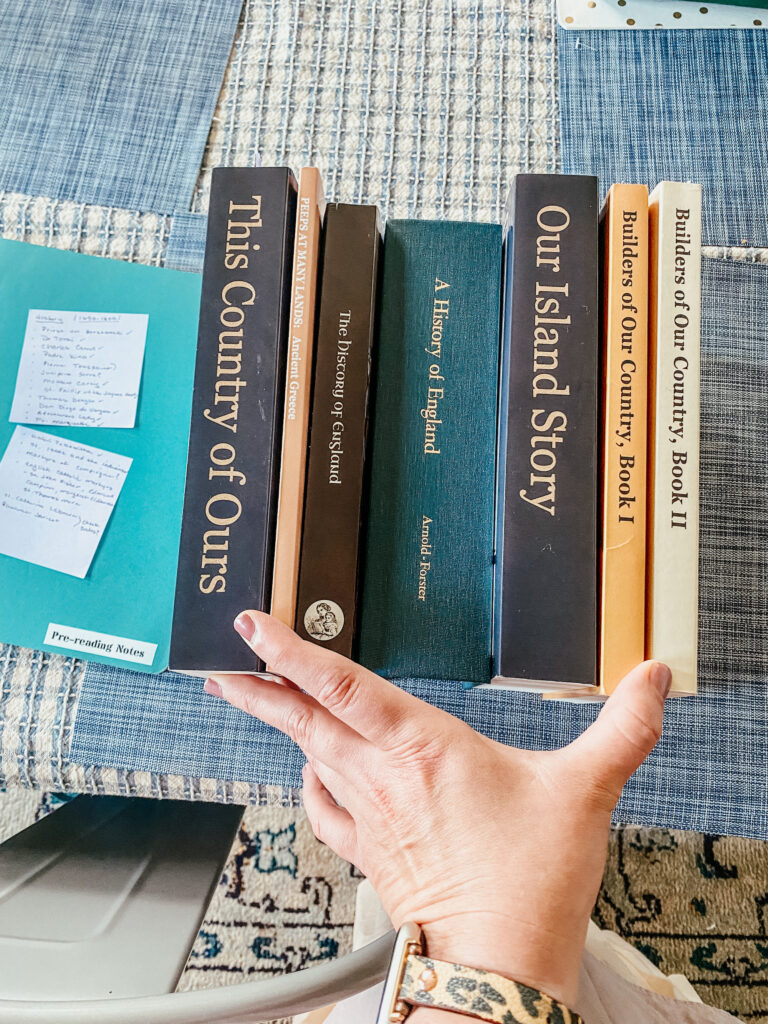
In year 3, we began reading through Pioneers & Patriots together slowly. We will continue with this book for years 4, and 5. And we introduce British history now in year 4. This is our favorite English history book: A History of England for Catholic Children: From the Earliest Times to 1850.
For ancient history, we begin with Egypt and Peeps of Many Lands.
Geography will read through the first half of North America and do map work in their geography notebooks. The student will also read through Marco Polo and 1-2 of the books from the He Went With Series as time allows.
At this level, the student is doing independent map work from their readings.
Biographies:
The children will have a block for history biographies to read independently on their time table twice a week. They will also work on history charts + notebooks during specific time blocks in the afternoons.
Usually, I will assign from something in the time period that they are currently reading from. Here’s just a few of our favorites:
- Mathew Carey: Pamphleteer for Freedom
- Charles Carroll and the American Revolution
- Kateri Tekakwitha: Mohawk Maiden
- Pierre Toussaint: A Citizen of Old New York
- Priest on Horseback: Father Farmer
- De Tonti of the Iron Hand and the Exploration of the Mississippi
- Padre Kino and the Trail to the Pacific
- Don Diego de Vargas: The Peaceful Conquistador
- Colonial Governor Thomas Dongan
- Blackrobe Peacemaker: Pierre De Smet
- Adventurous Lady: Margaret Brent of Maryland
- Chuiraquimba and Black Robes
There are also many others that are published by Hillside Education that we enjoy.
Citizenship
Next year, the student begins their first reading of Plutarch. So, I’ve found that our family has done well with reading these The Children’s Plutarch books in year 4 to help build or lay the foundation for reading Plutarch in year 5. We read and compare various lives from Tales of the Greeks and Tales of the Romans.
This Plutarch’s Lives: for Boys and Girls is another great option that we’ve used.
Literature
These are the books that we will read aloud from, sometimes during specific blocks during the school day, and sometimes in free time, afternoon blocks, or at bedtime. At this point, the student does read many of their books independently with narrations and check-ins with me.
We’ve also taken advantage of using a Yoto on occasion for some books.
- Hans Brinker
- Tom Sawyer
- Prince & the Pauper
- Marjorie Daw
- Penrod
- Penrod & Sam
- Swiss Family Robinson
- Brighty of Grand Canyon (and others by Marguerite Henry)
Poetry
In year 4, my children continue using Harp & Laurel Wreath for their poetry “spine”. I just purchase their own individual copy to keep and use for memory work, copywork, dictation, etc.
We also read through Shakespeare in year 4, but this has always been done as a common family subject in our home. And we really enjoy it together. Read more about our Shakespeare plans here.
Myths + Legends
In year 4, we begin Norse mythology with reading through Heroes of Asgard. The student will also read through Rip Van Winkle and other stories by Washington Irving.
Fables + Fairy Tales
We read through Aesop’s Fables together as a family each morning and then re-read through the book once finished. When the children get into upper forms, they move on to independently reading this version of fables.
In year 4, we continue reading through Andrew Lang’s fairy books, with the Red Fairy Book. And something, that we’ve enjoyed in year 4 is this strange and delightfully weird book, The Marvelous Adventures and Rare Conceits of Master Tyll Owlglass.
Language Arts + Latin
The basis of a language arts in a classical Charlotte Mason education is through narration, copywork, and dictation. Dictation and grammar are introduced this year.
We also introduce written narrations this year. Depending on when the student is ready, it usually begins for us towards the beginning of term 3.
Year 4 language arts:
- Oral and/or drawn narration
- Copywork
- Dictation
- Grammar
We also continue with cursive practice and cursive copywork. We’ve enjoyed the simplicity of this book for gentle grammar lessons in years 4-6. I’ve also pulled a bit from Charlotte Mason’s First Grammar Lessons.
Related: The Foundations of Language Arts in a Classical Charlotte Mason Education
Year 4 is when the student begins their first formal year of Latin in our homeschool. We’ve tried a few different programs over the years, and many are really great. But, we’ve found that this getting started book is a great place for us to begin in year 4.
As Traditional Catholics, Latin is a huge part of our everyday lives. And as such, we begin the early years with learning prayers in latin, singing of hymns, and even simple chants.
We’ve enjoyed Lingua Angelica as a great introduction to traditional Latin hymns.
Natural History, Nature Study, science
This year the student begins to study the sciences a little more in depth, but still poetically, and not analytically at this age.
- Handbook of Nature Study
- Nature Journals
- Star Lore — a variety of books and resources + star gazing
- Seasonal nature books
- The Storybook of Science
- Madam How and Lady Why
- Easy Experiments in Elementary Science
Common Family Subjects
I have written up separately about what we will study together as a family. Bible, devotionals, Shakespeare, artist study, etc are included in these posts. They are usually listed by the year’s curriculum picks.
Here’s just some of the things we accomplish during family time blocks:
- Hymns + Folk Songs — I use seasonal or liturgical hymns (mostly in Latin). Lingua Angelica (skip the workbooks) is a great place to start if you’re new to Latin hymns.
- Artist study + Composer study
- Fables—daily a short reading from Aesop
- Habit training — from Simply Charlotte Mason. And we enjoy these manners of the week cards.
- Shakespeare — on Fridays only. See more about how we learn Shakespeare together.
We also have blocks in the afternoon time each day where we loop through these together:
- gymnastics, folk dancing, Swedish drill, or other physical exercise; together daily. The Schoolyard Co has great options for Swedish Drill and other physical activities. I have a coupon code for you to save 10% off at The Schoolyard if you’re interested. Use code: MARYWOITA for 10% OFF.
- term biographies, and more lives of the saints / catholic heroes
- nature study + natural history reading
- Latin (short practice)
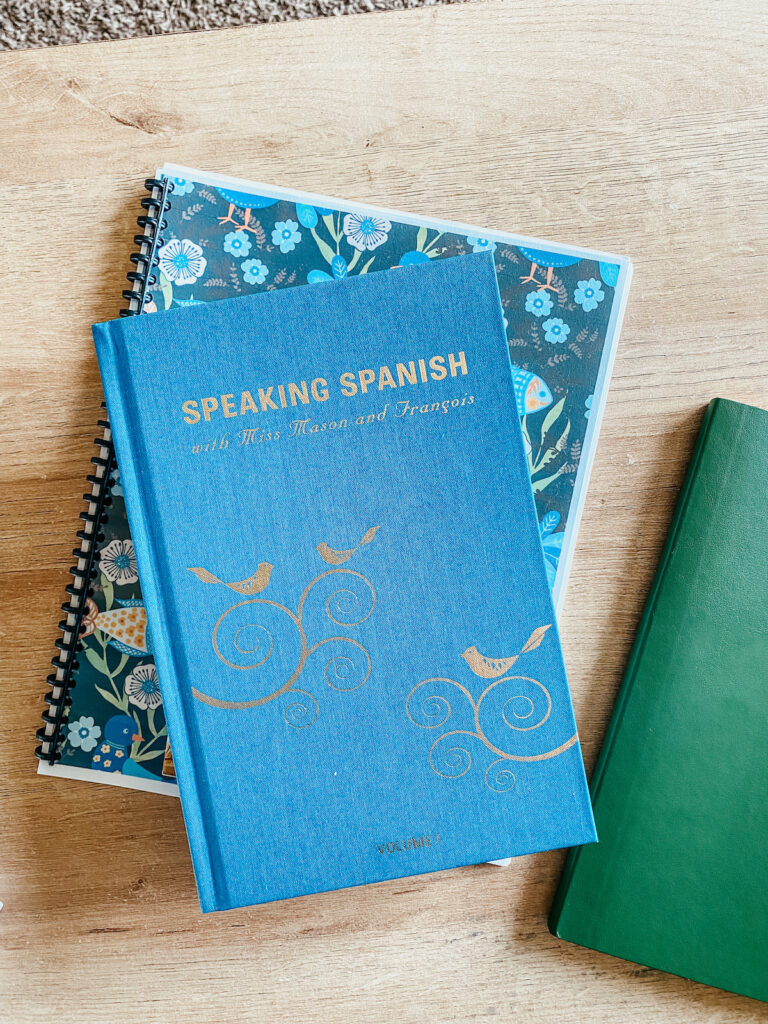
- Spanish and soon to be French
- literature or term novel
- poetry + tea time
- current events
- handicrafts
- watercolor lessons
Here are a few more related posts for common subjects:
- Morning Time
- Shakespeare + favorite resources
- Fairytales, Fables, Legends, and Myths in a Catholic Education
- Musical Education in our Homeschool
- Favorite Catechism Resources in Our Catholic Home
- Charlotte Mason Picture Study as Formation in Wonder
- Favorite Nature Study Resources