Disclosure: Joyfully Domestic may earn a commission for purchases made after clicking links on this page. View our disclosure policy for details.
One of the questions I receive most often from fellow mothers is how to make room for our own learning. Many of us homeschool moms spend our days spreading a rich feast for our children. But somewhere along the way, we forget that we are hungry too.
That is what mother’s scholé is all about.
“As St. Paul points out, Christ never meant that we were to remain children in intelligence: on the contrary. He told us to be not only ‘as harmless as doves,’ but also ‘as wise as serpents.’ He wants a child’s heart, but a grown-up’s head. He wants us to be simple, single-minded, affectionate, and teachable, as good children are; but He also wants every bit of intelligence we have to be alert at its job, and in first-class fighting trim.”
-C.S. Lewis, Mere Christianity
I have been a mother for nearly 14 years and homeschooling for 8, and I have been a Charlotte Mason homeschooler from the very beginning. Over these years, I have continued to take mother’s educational courses and to read as much as I can. And not because I have endless hours to spare (I certainly don’t!), but because a mother who keeps learning brings something living into her home.
In this little guide, I’m sharing what mother’s scholé is, along with three simple ways to pursue the intellectual life right where you are. None of them require a quiet house, a perfect schedule, or anything new to buy.
So, let’s dive in…

What Is Mother’s Scholé?
Scholé (pronounced SKOH-lay) is the Greek word for leisure. It is also the root of our word “school.”
But this is not leisure the way the modern world thinks of it. It isn’t scrolling, shopping, or zoning out at the end of a long day. To the ancients, and later to the great Catholic thinkers, leisure meant restful attention. It was time set apart to contemplate what is True, Good, and Beautiful.
If you would like to read more about this idea, Josef Pieper’s little book, Leisure: The Basis of Culture, is a wonderful place to start.
Mother’s scholé, then, is simply the mother-teacher making room for her own education. It is reading living books for ourselves, and not only aloud to our children. It is wondering, pondering, and growing in wisdom right alongside them.
Charlotte Mason reminds us that “education is an atmosphere, a discipline, a life.” And the atmosphere of our homes is shaped, in large part, by us.
Which brings me to the good news. Scholé does not ask us to add one more thing to an already full day. It asks us to receive our days a little differently. So how can we do this when many of us are already incredibly busy? I put together 3 very simple ways to add in a little bit of scholé, without any added stress.
Way 1: Keep a Book of Your Own
The simplest place to begin is with one good book that is just for you.
Not a planning guide or a curriculum manual. Those have their place, but choose something living: a classic novel, a work by one of the saints, a volume of poetry, or one of Charlotte Mason’s own volumes. Then keep it where your hands will find it, whether that’s beside the kettle, on the arm of the couch, or tucked into your basket.
Ten or fifteen minutes a day is plenty. Charlotte Mason asked for short lessons for our children, and that same gentle principle serves us well.
You might also keep a simple notebook nearby. Copy out a line that stirs you, or jot down a question you want to ponder. Many Charlotte Mason mothers keep this as a commonplace book, much like the ones we encourage our older students to keep. Over time, it becomes a quiet record of your own formation.
And if you aren’t sure where to begin, Charlotte Mason’s volumes are a lovely choice. I have read and re-read through them over the years. Each time, I find something new.

Way 2: Learn Alongside Your Children
Our homeschool is not only for our children; it can be one of the richest places for our own learning, too!
We sit down for Morning Time, recite poetry, study a painting, or read Shakespeare over a pot of tea, we don’t have to simply supervise these activities. We can receive the very same feast! In our home, tea time with poetry and Shakespeare and our weekly Fine Arts Friday have become some of the sweetest moments of the week.
So, try coming to these lessons as a learner yourself. Listen to the poem as if you were hearing it for the first time. Narrate the picture study along with your children. And ask your own questions.
The same is true out of doors. Bring a nature notebook of your own on your next walk and sit down beside your children to sketch that leaf or wildflower. (It doesn’t need to be beautiful or perfect.)
Charlotte Mason describes education as “the science of relations.” Our children are forming relationships with ideas, with nature, and with people. And so are we.
And as the children get older and begin more independent studies, we can begin to create a more in-depth scholé or academia for ourselves.

Way 3: Root Your Study in Prayer and Recollection
This last way is really the heart of the other two. Because this is our ultimate goal as we live a life of wonder for our children and ourselves.
True scholé is not about becoming more impressive or more well-read. It is contemplative and it leads us toward God. Charlotte Mason says it beautifully:
“We hold that all education is divine; that every good gift of knowledge and insight comes from above, that the Lord the Holy Spirit is the supreme educator of mankind, and that the culmination of all education (which may, at the same time, be reached by a little child) is that personal knowledge of and intimacy with God in which our being finds its fullest perfection.” —Charlotte Mason, Vol. 3, School Education, p. 95
So, begin your reading time with a short prayer to the Holy Ghost, asking Him to be your teacher. Then carry one line or one thought with you into the rest of the day. Ponder it while you fold laundry, stir the soup, or wait in the grocery line.
St. Teresa of Jesus reminds us that the Lord is found even among the pots and pans. As a Carmelite Tertiary, I have found that learning to stay in the Presence of God has shaped the way I approach motherhood. And it has led me, little by little, toward forming my children through wonder.
The busy mother’s day is not an obstacle to the contemplative life. Instead it is the very place where we can grow in holiness.
A Gentle Place to Begin
You don’t need to start all three at once. In fact, I would encourage you not to.
Choose one small step for this week. Maybe it’s setting a book beside the kettle, or joining your children for poetry at tea time as a fellow learner, or saying a short prayer before you open your book. Then let it grow from there.
Here are a few questions to ponder as you begin:
- What is one book I have been longing to read, just for myself?
- Which part of our school day could I receive as a learner, and not only as a teacher?
- Where in my ordinary day could I pause to recollect myself in the Presence of God?
- What does restful attention look like in this season of my life?
You might write your answers in that new notebook. It would make a lovely first page to your commonplace book!

A Closing Word
In today’s fast-paced modern world, it is easy to believe that the intellectual life belongs to someone else; maybe someone with more time, more quiet, or more letters after her name.
But the contemplative life is attainable for each of us, right where we are.
As Catholic mothers and home educators, we have the opportunity to cultivate wonder, contemplation, and a love for what is True, Good, and Beautiful in our children’s hearts (as well as our own!). And every small step we take toward scholé is a step toward Him.
I’d love to hear what resonates most with you. Simply comment below and let me know which of these three ways you plan to try first. Or share with us how you incorporate Mother’s Scholé into your days.
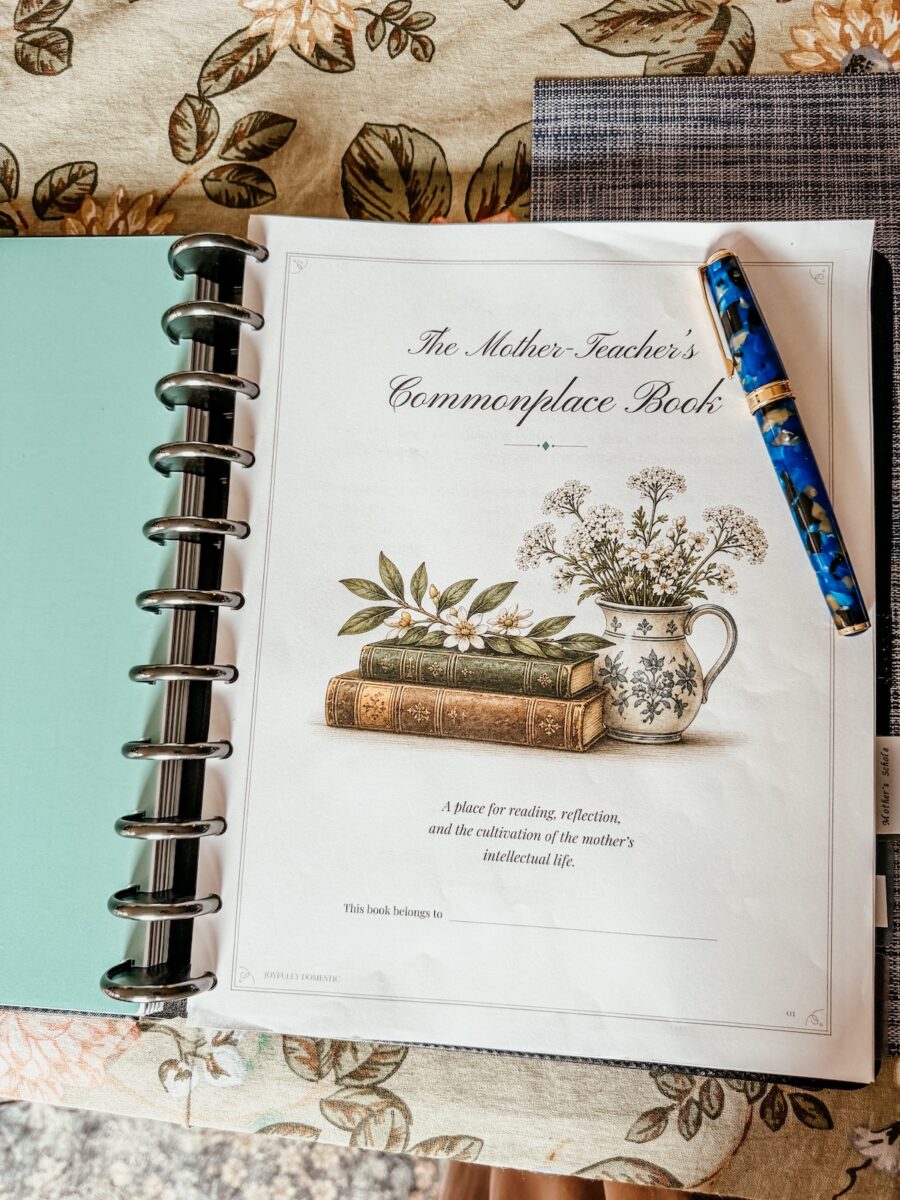
The Mother-Teacher’s Commonplace Book
As we already mentioned in this post, we are busy homeschooling mothers, we spend a great deal of time thinking about our children’s education. We carefully choose books, introduce worthy ideas, and encourage them to develop habits of attention, observation, and reflection.
But our own education matters, too.
I created The Mother-Teacher’s Commonplace Book as a simple, beautiful place for mothers to continue cultivating their own intellectual lives.
Inspired by the tradition of commonplace keeping, this printable notebook provides a place to collect meaningful quotations, record thoughts from your reading, pursue interesting questions, and reflect on the ideas you encounter.
Whether you’re studying Charlotte Mason’s philosophy, reading the works of the saints, exploring history and literature, or simply enjoying a good book, these pages offer a quiet place to preserve what you’ve learned.
It’s a lovely companion for mother’s scholé or mother academia, designed to encourage continued learning without becoming another task to complete.
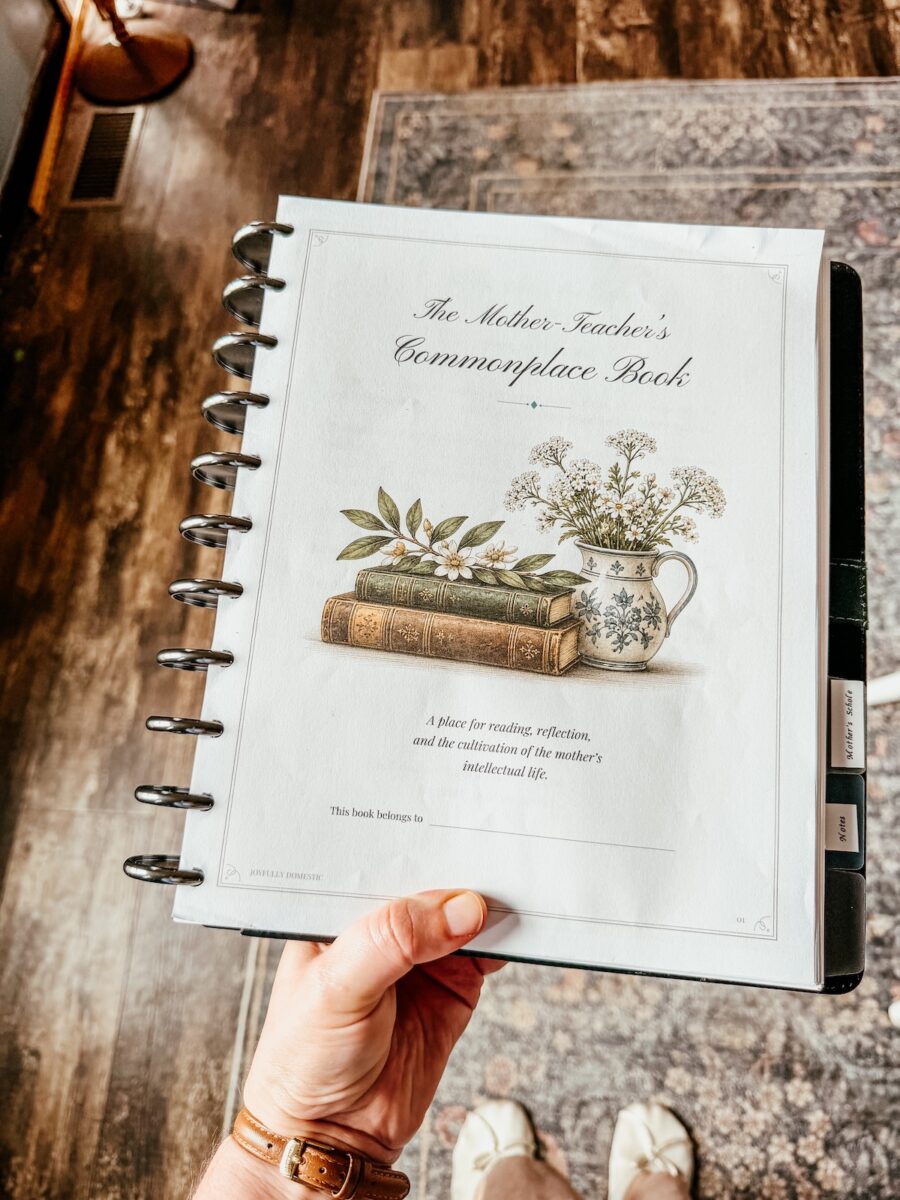

I printed mine and keep in my discount teacher’s planner for ease and organization.